
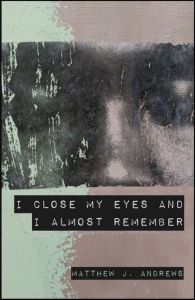
 In his debut poetry collection, I Close My Eyes and I Almost Remember, Matthew J. Andrews takes a creative, and somewhat dark, look into the lives of different people from the Bible. In the book’s description, Andrews states that these poems were “born of spiritual crisis,” which is exactly what this collection feels like. Each poem is filled with doubt, struggle, and the weight of consequence as he guides the reader through the imagined perspectives of various Bible characters from Genesis to Revelation. What stands out the most in this collection is that the transformative power of God’s love is largely absent; Andrews leaves God’s actions and the tremendous weight those actions leave on mankind, but without the comfort of God’s love and His promise for a glorious future. In these poems, God is closely associated with fire, while ash lies in the wake of His intensity. Those who encounter God, rather than God Himself, are the focus. Each poem presents subtle reminders of man’s frailty and mortality by evoking images from creation—dirt, dust, ash, water, breath, and blood. These images capture our weaknesses and the frustration of human existence, reminders that we come from dust and to dust we shall return. After the suffering and struggles seem to end in the final poem, “The Gardener,” the reader is reminded that it’s all to begin again, as the Gardener feels the desire to plant a new Eden. The trail of pain and hardship traveled as the result of the events in the last garden makes the reader feel hesitant—was it all worth it? Will it be any better next time?
The more I read and meditate on each poem, the more I experience Andrews’ amazing capability to make each person of the Bible come alive with his or her humanity laid bare. My favorites are “Exile” and “Unfinished Psalms from the Private Notebook of King David,” though all of the poems were able to captivate with their unique viewpoints. This poetry collection is a great read for anyone familiar with the Bible, and will likely prove to be especially rich for those well-acquainted with the stories Andrews uses for inspiration (he does provide notes for context). In the poem, “Mary Remembers,” the speaker (presumably Mary) states, “I have heard the story so many times, I close my eyes and I almost remember.” If you feel you have heard these Bible stories “so many times,” then I recommend this book. Andrews causes you to forget what you know, and see these people with fresh eyes. At the same time, he causes you to think deeply on the relationship between God and man, pointing to the struggles and doubts that occur in all of us, and offering no easy answers.
 Veronica McDonald