Day 5 (and 6): The Stafford Challenge – Two for … Wednesday?

Well, I dropped the ball yesterday and didn’t get my poem posted. So, that makes today a two-for day! I only wish it was Tuesday and not Wednesday so I would have that wonderful alliteration for today’s title.

These poems got a little dark on me, but I think this almost always tends to happen when I write. I do embrace the light in my life (abiding in Jesus is the only place to find true peace), but when I write, whatever I’m troubled about comes through. I hope if you are reading this you find them intriguing.

Day 5 (and 6).


Judge Not

The judgment finger is upon her. She turns to the wall, accepts death, weeps bitterly from the mouth that used to laugh at the prophet. “This one only ever tells me bad news. Where’s that girl who only ever tells me bad news?” Her goblet slopping fine wine down her fingers glistening with polish and jewels. “You are well, princess! You are loved! Your life will be nothing if not romance and pleasure for all your days!” She laughs, white teeth shining, smoky eyes lazily glancing over the overdressed dead under black, weighty lashes. “Where is the one who always gives bad news?” “Gone! Gone!” They bow, hoping to please. ” We beat her, excluded her, wrote nasty things on her social media. You’ll never hear her ugly, plain words again!” And she runs her weak fingers down the stucco wall against her bed, thoughts swimming and lingering with dread.


Something Hurts

Uneasy in spirit and soul. Electricity tickling the back of my neck. Part of it, a face in pain. The one I love. The look in his eyes touching somewhere I’m not conscious. The other part, the death of someone I said was nice. Who’s that? I don’t really know him. We met a couple times. He’s nice. Found dead. Took a minute because he’s always alone. Nothing unusual, even when the dogs barked a little more. He’s nice. But dead. Found naked. Alone. Dirty dishes. Dog feces. Face down. Found him there. Skin like wax. Cold. Alone. Thought I would have to explain the broken door. Apologize. Say, I’m sorry, dude, we were only worried you weren’t answering your phone. Stacks of filth. Something lingers on the back of my neck. He’s nice. He was nice. A nice guy.

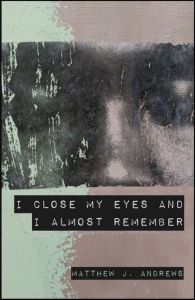
Book Review: ‘I Close My Eyes and I Almost Remember’ by Matthew J. Andrews

In his debut poetry collection, I Close My Eyes and I Almost Remember, Matthew J. Andrews takes a creative, and somewhat dark, look into the lives of different people from the Bible. In the book’s description, Andrews states that these poems were “born of spiritual crisis,” which is exactly what this collection feels like. Each poem is filled with doubt, struggle, and the weight of consequence as he guides the reader through the imagined perspectives of various Bible characters from Genesis to Revelation. What stands out the most in this collection is that the transformative power of God’s love is largely absent; Andrews leaves God’s actions and the tremendous weight those actions leave on mankind, but without the comfort of God’s love and His promise for a glorious future. In these poems, God is closely associated with fire, while ash lies in the wake of His intensity. Those who encounter God, rather than God Himself, are the focus. Each poem presents subtle reminders of man’s frailty and mortality by evoking images from creation—dirt, dust, ash, water, breath, and blood. These images capture our weaknesses and the frustration of human existence, reminders that we come from dust and to dust we shall return. After the suffering and struggles seem to end in the final poem, “The Gardener,” the reader is reminded that it’s all to begin again, as the Gardener feels the desire to plant a new Eden. The trail of pain and hardship traveled as the result of the events in the last garden makes the reader feel hesitant—was it all worth it? Will it be any better next time?

The more I read and meditate on each poem, the more I experience Andrews’ amazing capability to make each person of the Bible come alive with his or her humanity laid bare. My favorites are “Exile” and “Unfinished Psalms from the Private Notebook of King David,” though all of the poems were able to captivate with their unique viewpoints. This poetry collection is a great read for anyone familiar with the Bible, and will likely prove to be especially rich for those well-acquainted with the stories Andrews uses for inspiration (he does provide notes for context). In the poem, “Mary Remembers,” the speaker (presumably Mary) states, “I have heard the story so many times, I close my eyes and I almost remember.” If you feel you have heard these Bible stories “so many times,” then I recommend this book. Andrews causes you to forget what you know, and see these people with fresh eyes. At the same time, he causes you to think deeply on the relationship between God and man, pointing to the struggles and doubts that occur in all of us, and offering no easy answers.

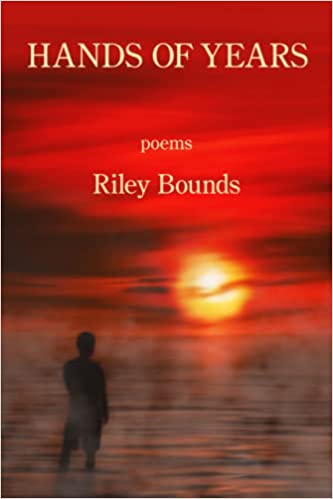
Book Review: ‘Hands of Years’ by Riley Bounds

In his debut poetry chapbook Hands of Years, Riley Bounds starts with the waste buried “at the tale end of the earth” and slowly works his way through a harrowing path, one that is never easy but gravitates unsteadily towards the light of Christ. In the first few poems, Riley describes a world marked by death—one where “strays” die alone in a universe consisting of the broken pieces of harsh reality. He then moves across the brokenness to shatter our beacons of earthly comforts—the apologist, the angel, mother, father, rainbows, even dogs. As he sifts through the glass shards and ashes, one hope awaits in the peripheral. The poem “Doxology.” is a turning point, a return to a childlike state and to the foundations of faith, building anew out of the wreckage. The result is a relief; the last poems “Dusk Hymn.” and “Prayer.” are a final release into the light of day after wandering in darkness. The book begins and ends with a “pirouette:” from the meaningless and bleak dance of particles, to smiling individuals (“innumerable as the dust”) engaged in a cosmic dance with the Creator. By the end, the “atoms” of mortality are shed, and the speaker finally finds what he is looking for, in the first word of the final poem: hope—the hope for “netted souls, refracting each other’s given light” to become meaningful beings through the act of singing praise. The lost beacons are fulfilled in Christ Himself—“He smiles for me, the smile my father never could and the smile my mother never gave me”—leaving both speaker and reader with a sense of restoration and healing.

A few of my favorites from this collection are “Canticle.,” “Cass.,” “Mother.,” and “Father.,” though each piece holds memorable lines and imagery that I anticipate readers will return to over and over.

Hands of Years is a short but powerful and honest exploration for hope in a broken life— a quest for God when He seems absent. This book will speak deeply to those searching for hope as well as those going through the struggles that sometimes come with faith.  I find Riley Bounds’ ability to carry such weight in few words impressive, and I look forward to reading more of his work in the future. I highly recommend it.